| Home Page | History | Village Life | Bus Timetable | Parish Church | Parish Council | Local Walks |
|
|
St. Michael |
|
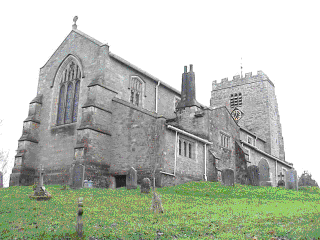
Whittington Church stands on an ancient site of a motte and bailey castle. It is believed there has been a church on this site since the year 1200. In the churchyard many old stones can be seen dating back to Norman times. The tower is the oldest part, built in the 15th Century and the height is fifty feet. It has a spiral stair contained in the north east corner, and diagonal buttresses. On the west side of the Tower, between the window and the belfry, there is a niche, containing a Victorian figure of the Good Shepherd. Fragments of stones in the doorway are reputed to go back to the time of William the Conqueror. Apart from the Tower, the external appearance of the church is Gothic, and this is due to the fact that major restoration took place in 1875, carried out by the Lancaster architects Paley and Austin. Its cost was met mainly by Colonel D. C. Greene of nearby Whittington Hall. |
|
|
The Tower contains a peal of six bells, just double the number contained before the restoration. The treble is by E. Seller of York 1739, inscribed ‘Gloria in Altissimis Deo’ and with the names of George Hornby, rector, and four church wardens. The second, inscribed ‘Prosperity to this Parish’ is by A. Rudhall 1754. The third, fourth and fifth are by Taylor & Co. of Loughborough 1875. The tenor is a recasting in 1875, also by Taylor, of a bell founded in 1673, and bears both dates. Both local teams and visitors ring from time to time, and the peal is of a very high quality. |
|
|
|
To the west of the church there is a mound which may have been a Norse moothill (meeting place). On this there is a sundial on a square base of five steps, which may have been the steps of a cross. As you enter the church, there is a detailed plan to the left, which even portrays the tiles! There is also the first of three one-light stained glass windows, which was vandalised and completely restored in 1991 by Abbots of Lancaster (see stained glass windows). |
|
THE FACT THAT THIS CHURCH "Olyvere Northe of Dockare Pysh of |
|
|
|
There is a large Victorian font of polished limestone replacing the 17th Century circular stone font, situated to the right of the steps. The pews were all replaced in 1875 and it is possible that the vestry panelling was made from part of the old pews. The Nave and Chancel are divided by a beautifully carved light oak screen, and the stone carved reredos is of excellent workmanship. |
|
The church of St. Michael the Archangel at Whittington has registers dating back to 1538, the year Thomas Cromwell ordered them to be started. They are bound in calf skin and immaculately written in copper plate. In 1991 a missing register was discovered in an old safe, the key of which came to light during a 'boon' day! This then completed the unbroken original records, which are now safely stored in archives at Preston. |
|
|
The church plate is very fine, including a 17th Century silver gilt flagon in memory of Richard Jackson, and early rector. The paten and chalice also bear the makers initials - W.R. A silver chalice, made to a design by Miss Elizabeth North, was presented to the church in 1983. For security reasons these items can no longer be kept in the church. The accompanying photograph of the communion plate is from the collection of photographic plates left by the Rev. John Hodgkin, who's collection is shown elswhere on this website |
|
|
|
|
|
Five of the stained glass windows, the two large windows at the East and West of the church and three one light windows were inserted at the time of the church restoration in 1875. These are by James Powell & Sons of Whitefriars Studios, London. The West window (possibly designed by Holiday) has deteriorated very badly, and this is thought to be due to inclusion of borax in the paint and poor firing. These windows were donated by the Greene family of Whittington Hall.  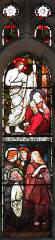 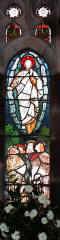
|
  |
|
View all the Windows
Two further windows on the South side were inserted in 1922 in memory of members of the Greene family. These are by Charles Kempe, probably designed by John Lyle. When Kempe died in 1907 he left his business to his relation Walter Tower, which explains the signatures in the bottom left hand corners, a wheatsheaf (Kempe) with a tower (Tower) superimposed upon it. The remaining window on the South side is quite recent, in memory of the Howarth family. This represents St. Blaise, the patron of woolcombers and woolstaplers, and is by Lawrence Lee. |
|
|
|
|
|
There is a moulded base of a 13th Century pier, used in a reverse position as one of the present piers of the north arcade. The roll of honour can be seen on the South wall, brought from the school when it was closed. It is interesting to note that many successors of the families mentioned are still living in the village, worshiping at and helping to maintain this lovely church. Outside the entrance to the church is the Memorial to those who gave up their lives during the First World War. |
|
|
|
To commemorate the millennium, a mosaic depicting St. Michael the Archangel, designed and constructed by Maggie Howarth, was installed at the entrance to the churchyard. A project, involving many of the villagers, enabled us to complete the cobbling surrounding the mosaic. Cobbles were gathered from the Lune and then installed under Maggie Howarth's supervision. |




 .
.