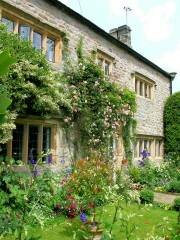
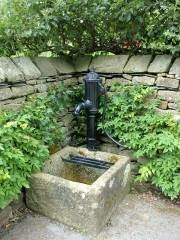
Village PumpWhittington in the Vale of LuneManor House

Home Page History Village Life Bus Timetable Parish Church Parish Council Local Walks


Hugh William Mackay, 14th Lord Reay, Baron Mackay
(19 July 1937 - 10 May 2013


Politician and Conservative member of the House of Lords. Hugh William, Mckay was the only male Lord of Parliament to sit in the House of Lords, the only female being the Lady Saltoun. He was educated at Eton College and Christ Church, Oxford and resident at Whittington Hall.

Lord Reay was the only son of Aeneas Alexander Mackay, 13th Lord Reay and succeeded to the title upon his father's death in 1963. Lord Reay sat as an appointed Member of the European Parliament from 1973 until the first elections in 1979.

Lord Reay was subsequently appointed as a House of Lords whip in 1989 by Margaret Thatcher. In 1991, he was moved by her successor, John Major, to the Department of Trade and Industry as a Parliamentary Under Secretary of State, but he left the government at the 1992 general election.

With the passage of the House of Lords Act 1999, Lord Reay along with almost all other hereditary peers lost his automatic right to sit in the House of Lords, however, he was one of the 92 elected hereditary peers to remain in the House of Lords pending completion of House of Lords reform.

Lord Reay was the hereditary Clan Chief of Clan Mackay. The family holds an ancient Scottish title – dating from 1628. He was also Baronet of Farm, a Nova Scotia title bestowed by James VI, of Scotland (and I of England), on a forebear in 1627. His father inherited a barony in the Netherlands through the Dutch branch of the Mackay family, so on his father’s death in 1963, Lord Reay also became Baron of Ophemert and Zennewijnen. That had been created in 1822 by King William I of the Netherlands and the family still owns the delightful 16th-century fort Ophemert.


Aeneas Alexander Mackay

Lord Hugh Reay

Lord Reay was married twice. With his first wife Tessa, (née the Honourable Annabel Terese Fraser), a daughter of Lord Lovat (she is now wife of Henry Keswick), he had two sons and one daughter. With his second wife Hon. Victoria Isabella (Nee Warrender), youngest daughter of the late Victor Alexander George Anthony Warrender, 1st Baron Bruntisfield, he had two daughters.

He is succeeded by his eldest son Ćneas Simon Mackay, Master of Reay (born 20 March 1965), a banker. On the 14 Jan 2010 he married Mia Ruulio, elder daughter of Markus Ruulio of Helsinki. His heir is his son the Honourable Alexander Shimi Markus Mackay (born 21 April 2010).

Lady Elizabeth Fairbairn, Lord Hugh Reay’s sister, has taken on many of the responsibilities connected with the clan and acts as its president. She confirmed to The Scotsman that Lord Reay was proud of his Scottish heritage. “Hugh often attended clan gatherings and dinners and spoke with authority on a number of subjects related to the north of Scotland – especially the Highland Clearances. He was also against wind farms intruding on the moors of Sutherland. “I kept him well informed about the activities of the clan and we spoke regularly.”

In the European Parliament he was in the forefront of the campaign to restrict the commission’s expenditure. He particularly took issue that its administration was centred in three cities (Brussels, Strasbourg and Luxembourg) and strenuously advocated one central location.


Lord Hugh and Lady Victoria Reay

Lord Reay was a dapper man who always took pride in his appearance. Although not often in Mackay country, he cut a dashing figure in full highland dress. At official dinners, he wore the kilt with a specially made green jacket to complement the green, blue and black of the Mackay tartan. He attended the Gatherings in Edinburgh in 2000 and 2009.

At the former, Lord Reay, with his wife the Lady Victoria, walked down the Royal Mile in the parade in Mackay tartan with a grand cockade in his glengarry. In 2009 he visited the Mackay tent in kilt and glengarry and spoke enthusiastically of the work being done at the Clan Mackay Room at the Strathnaver Museum in Sutherland.

He said in a speech: "I have always had soft spot for Edinburgh, the place of my birth and still managing to hold its place as, in my opinion, the most beautiful city in the United Kingdom.

"I feel honoured to be amongst you. Clansmen, Clanswomen. I ask you to raise your glasses to the Clan Mackay." Lord Reay spent much of time between, London, the Netherlands and Lancashire. He was a keen angler and especially enjoyed fishing the Tweed. He was also an excellent shot. Lord Reay was a man of dignity and charm who combined the various disciplines of clan chief, politician and environmentalist with much grace.


The Clan Mackay Crest/Badge
Moto: Manunu Forti (With a strong hand)
War Cry: Bratach Bhan Chlann Aoidh

Clan Mackay (Gaelic: Mac Aoidh) is an ancient and once powerful Scottish clan from the far North of the Scottish Highlands. They supported Robert the Bruce during the Wars of Scottish Independence in the 14th century. In the centuries that followed they were anti-Jacobite.


The Gatherings

The territory of the Clan Mackay consisted of the parishes of Farr, Tongue, Durness and Eddrachillis, and was known as Strathnaver, in the north-west of the county of Sutherland. It was not until 1829 that it was considered part of Sutherland when the chief sold his lands to the Earls of Sutherland. The Highland Clearances had dire consequences for the clan. In the 17th century the Mackay chief's territory had extended to the east to include the parish of Reay in the west of the neighbouring county of Caithness.

Lord Reay is chief of the clan and the lands of Strathnaver later became known as the Reay Country.

The title Lord Reay was created in 1628 for the soldier Sir Donald Mackay, 1st Baronet. The year before he had been created a baronet, of Far, in the Baronetage of Nova Scotia. He was succeeded by his son, the second Lord, who fought as a Royalist in the Civil War. On the death of his great-great-great-grandson, the ninth Lord, the line of the eldest son of the second Lord failed. The late Lord was succeeded by his kinsman, the tenth Lord. He was the son of Barthold John Christian Mackay (who had been created Baron Mackay of Ophemert and Zennewijnen in the Netherlands in 1822), great-grandson of Hon. Aeneas Mackay, a Brigadier-General in the Dutch army and the second son of the second Lord.

Lord Reay was a Dutch citizen and served as a government minister in the Netherlands. His son, the eleventh Lord, became a British citizen in 1877 and four years later he was created Baron Reay, of Durness in the County of Sutherland, in the Peerage of the United Kingdom.

Lord Reay was later Governor of Bombay, Under-Secretary of State for India in the Liberal administration of Lord Rosebery and Lord Lieutenant of Roxburghshire .

On his death the UK Barony became extinct while he was succeeded in the other titles by his cousin, the twelfth Lord. He was the son of Baron Aeneas Mackay (1806-1876) (a Dutch politician who had been created Baron Mackay in the Netherlands in 1858), son of Johan Francois Hendrik Jakob Ernestus Mackay, brother of the tenth Lord Reay. He was also a Dutch citizen.

His son, the thirteenth Lord, became a British citizen in 1938 and later sat in the House of Lords as a Scottish Representative Peer. His only son Hugh William Mackay became the fourteenth Lord Reay on the death of his father in 1963. Hugh William Mackay the 14th Lord Reay was succeeded by his son Ćneas Simon Mackay as Master of Reay, the 15th Lord Reay and Baron MacKay in 2013.


Caithness Landscape

Lord Reay in Caithness folklore.

In the folklore of Caithness Lord Reay is a magician who believed he had come off best in an encounter with a witch in Smoo Cave. His prize was a gang of fairies who liked nothing better than to work. The construction of various earthworks in the parish of Reay are attributed to these fairies, working under direction from Lord Reay.

However, the fairies' appetite for work was insatiable and, eventually, their demands became intolerable. So Lord Reay put them to work building a causeway of sand across the Pentland Firth where, of course, the fierce currents wash away the sand just as fast as the fairies can build.


A drappie o' the real MacKay

The real McCoy.

The phrase "The real McCoy" is said to be a corruption of the Scots "The real MacKay", first recorded in 1856 as: "A drappie o' the real MacKay," (A drop of the real MacKay). This appeared in a poem Deil's Hallowe'en published in Glasgow and is widely accepted as the origin of the phrase. The 'real MacKay' expression occurs in Scottish newspapers quite frequently in the 1860s and must have been in common use in Scotland at that date. Nowadays it is accepted as an idiom and metaphor used in much of the English-speaking world to mean "the real thing" or "the genuine article", which seems to be highly appropriate.


(This text was originally sourced primarily from the Internet and the records of Parliament together with a very informative tribute in The Scotsman
(The text was last updated and corrected on the 26 September, 2013)
Top of Page